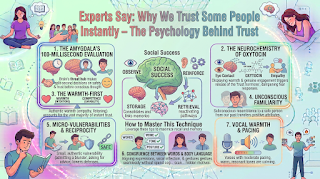
Have you ever met someone for the very first time and felt an immediate sense of comfort and safety around them? Within seconds of shaking hands or exchanging a brief greeting, your intuition signals that this person is reliable, honest, and safe to confide in. Conversely, you may have encountered people who triggered an immediate sense of unease without any clear explanation.
Trust feels like a conscious moral evaluation, but cognitive science reveals that instant trust is primarily a subconscious biological response. Your brain relies on rapid neural shortcuts, facial evaluation algorithms, and neurochemical signals to assess a stranger’s trustworthiness before you even finish saying hello. Here is the fascinating psychology behind why we trust some people instantly.
1. The Amygdala’s 100-Millisecond Evaluation
Long before your conscious mind weighs a person’s credentials or character, your amygdala—the brain’s threat-detection hub—makes an initial assessment of their trustworthiness in less than 100 milliseconds (a tenth of a second).
Researchers at Princeton University found that the brain evaluates facial structure for trust cues automatically and involuntarily. Micro-features like a slightly upturned mouth, slightly higher eyebrows, and open, warm eyes are processed instantly by the amygdala as signals of low physical threat, triggering an immediate feeling of psychological safety.
2. The Neurochemistry of Oxytocin
Trust is deeply rooted in neurobiology, specifically driven by the hormone and neurotransmitter oxytocin, often referred to as the “trust hormone.”
When you interact with someone who displays genuine warmth, eye contact, and active engagement, your brain releases small surges of oxytocin. This chemical dampens fear responses in the brain and increases willingness to take social risks. People who naturally radiate empathy and calm energy stimulate oxytocin production in others, creating an immediate biological foundation for trust.
3. The Warmth-First Framework
Social psychology shows that when we meet someone new, our brain evaluates them on two primary traits: Warmth (intentions) and Competence (capability).
While competence is valued in professional settings, warmth is evaluated first and accounts for the vast majority of instant trust. If someone communicates high competence without warmth, they can come across as intimidating or cold. However, when someone demonstrates authentic warmth—showing sincere interest in you, listening intently, and maintaining open body language—your brain registers their intentions as friendly, establishing instant rapport.
4. Unconscious Familiarity (The “Mere Exposure” Illusion)
Sometimes we trust a stranger instantly because they subconsciously remind us of someone safe from our past. Psychologists refer to this as transference or the mere exposure effect.
If a stranger shares a similar vocal cadence, facial structure, laugh, or demeanor with a trusted mentor, loving parent, or close childhood friend, your subconscious mind projects those positive attributes onto the new person. You feel as though you “already know them,” transforming a total stranger into someone who feels comforting and familiar.
5. Micro-Vulnerabilities and the Reciprocity Norm
Perfection creates distance, but subtle vulnerability builds immediate connection. Psychologists have found that people who show small, authentic signs of vulnerability—admitting a minor blunder, asking for a simple piece of advice, or sharing a candid thought—instantly lower the social defenses of those around them.
This triggers the norm of reciprocity: when someone drops their guard around you, your brain feels safe to drop its guard in return. This mutual exchange of vulnerability builds a bridge of trust in minutes that might otherwise take weeks to construct.
6. Congruence Between Words and Body Language
Human beings are exceptionally adept at detecting nonverbal dissonance. When someone’s words say one thing but their facial expressions, tone of voice, or posture suggest another, the brain flags them as insincere.
Instant trust occurs when a person displays high congruence—their facial expressions, vocal inflection, gestures, and spoken words are entirely aligned. When a person’s nonverbal cues match their verbal message seamlessly, your brain does not have to spend cognitive energy scanning for hidden motives or deceit.
7. Vocal Warmth and Pacing
The human voice is a powerful emotional transmitter. Speech pattern, pitch, and tempo play an immense role in how trustworthy someone appears.
Studies in acoustic psychology show that voices with lower pitch variations, moderate pacing, and warm, resonant tones are consistently rated as more trustworthy and calming. Rapid, erratic speech can trigger subconscious alert systems, whereas a steady, warm voice signals emotional stability, confidence, and composure.
How to Radiate Trustworthiness Authentically
While you cannot fake genuine character, you can align your social habits to communicate safety and warmth effectively:
- Prioritize Connection Over Convincing: Focus on making the other person feel heard and validated rather than trying to impress them with your accomplishments.
- Maintain Relaxed, Open Posture: Avoid crossing your arms, checking your phone, or angling your body away during conversation.
- Offer Undivided Presence: In a distracted world, giving someone your complete, unhurried attention is one of the fastest ways to build trust.
Conclusion
Instant trust is not a random coincidence; it is an evolutionary mechanism designed to identify allies, ensure safety, and foster human connection. By understanding the psychological triggers behind trust—from facial cues and vocal warmth to shared vulnerability—we can build more authentic relationships and navigate our social worlds with greater confidence and empathy.